Crafts of the Hand
اليد إذا عملت أحسنت
"The hand, when it labors, beautifies."

Five disciplines form the artisanal heart of Dar al-Hiraf. Each craft is learned gesture after gesture, under the guidance of a maalem, within the same rhythm as prayer, study, and communal life.
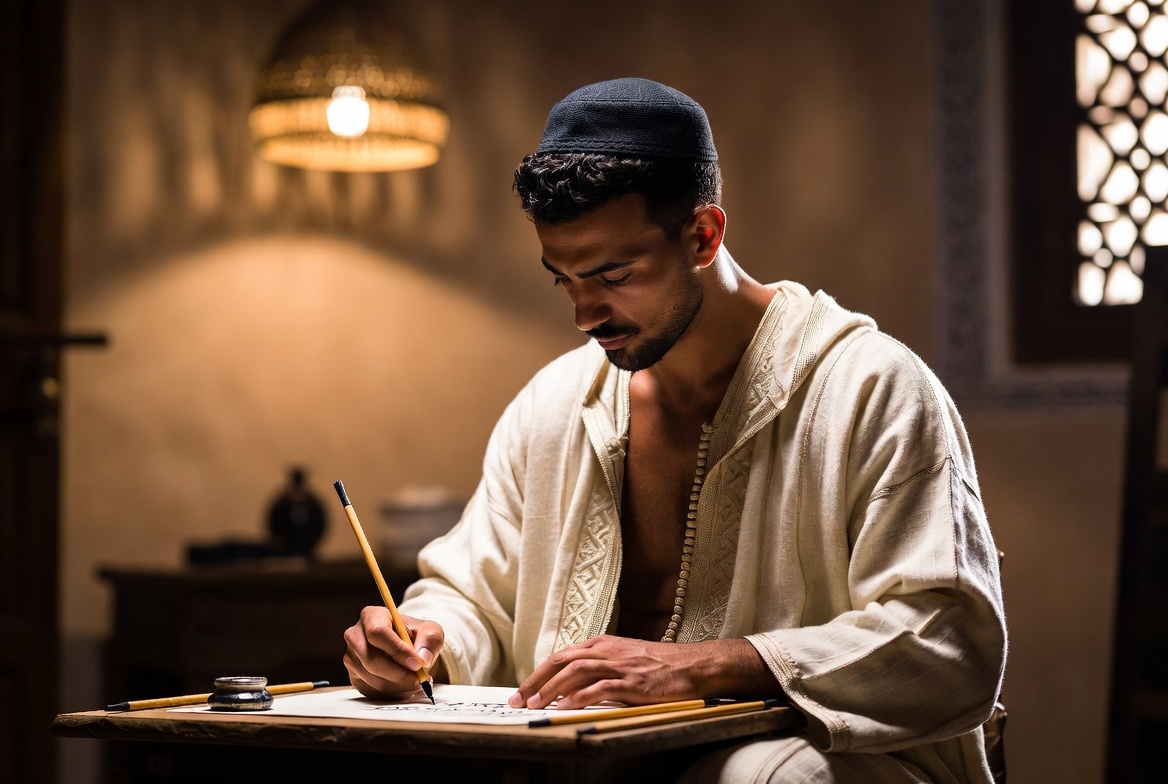
Calligraphy
The qalam, the page, the breath. Writing as an inner discipline.
The Maghreb developed its own script, khatt maghrebi — distinct from the eastern naskh or thuluth. Born in al-Andalus, it took root in Fès after the Reconquista. The basmala remains the first exercise of every apprentice calligrapher.
الخطُّ هندسةٌ روحانيةٌ ظهرتْ بآلةٍ جسمانيةٍ
"Calligraphy is a spiritual geometry made manifest through a bodily instrument." — Ibn Muqla
The basmala — bismillah al-rahman al-rahim — opens the Qur'an and gives rhythm to daily life. It is also the first exercise of every apprentice calligrapher: a founding gesture before it is a decorative motif, it has always adorned manuscript frontispieces, madrasa doorways, and mosque façades.
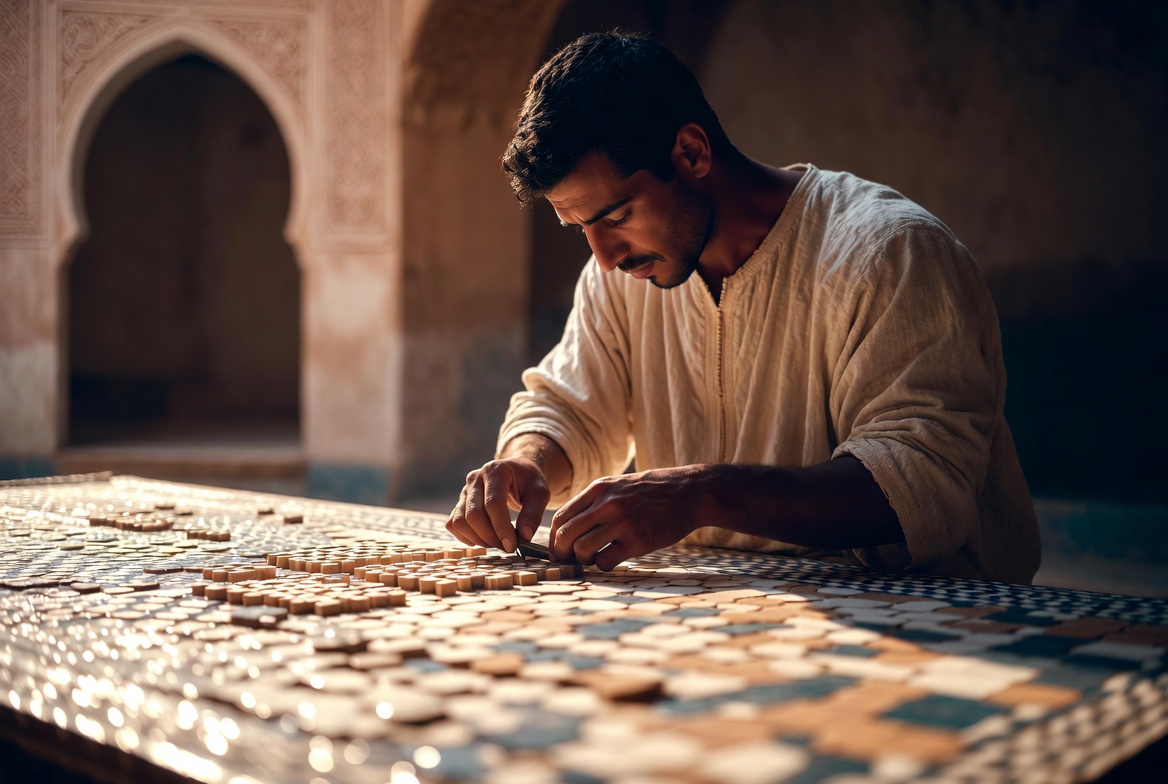
Zellige
Geometry, cutting, laying.
The term zillij comes from an Arabic root denoting the small polished stone. The art was born in Fès under the Marinids, in the 13th–14th centuries — the Bou Inania and al-ʿAttarin madrasas remain its most accomplished witnesses.
Each piece is cut separately with a hammer (minqash), from monochrome glazed tiles fired one at a time. Assembly is done face-down: the maalem composes the pattern with its hidden face upward, and turns it over only once it is finished — the geometric grids are memorized and passed down orally, like a musical repertoire.
This geometry is never purely decorative: the interlacing pattern, repeating with no visible beginning or end, is read, in Islamic thought, as an image of tawhid — the unity behind the multiplicity of forms.
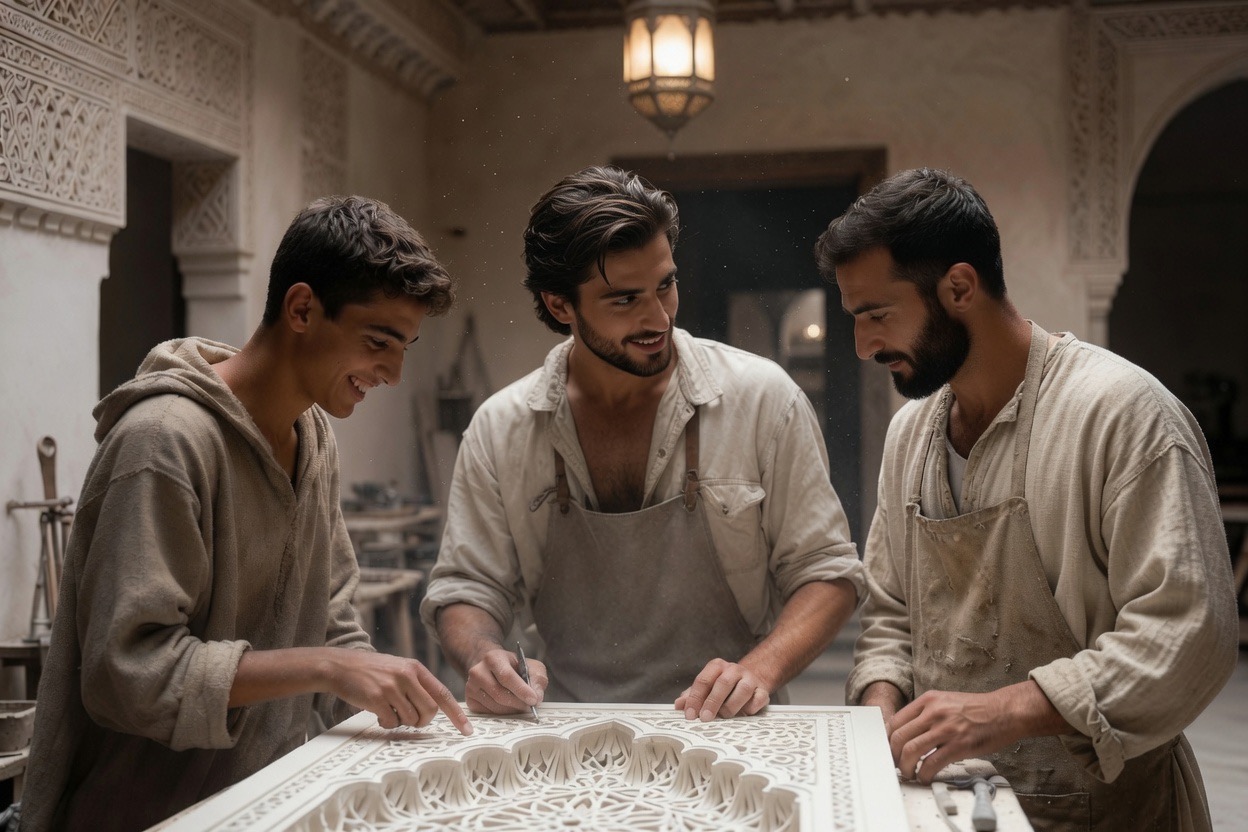
Plaster & Muqarnas
Carved stucco, relief, light.
The gesture was born in Samarra, the 9th-century Abbasid capital, where the first fully abstract ornamental style in Islamic art developed. It reached its full maturity later in al-Andalus and then in the Marinid Maghreb, with the muqarnas — the honeycomb-like cells covering domes and portals.
The muqarnas — carved plaster cells suspended like stalactites — probably arose in Persia and Mesopotamia in the 10th–11th centuries, but reached its full geometric maturity in al-Andalus and the Maghreb: the dome of the Hall of the Two Sisters, at the Alhambra, remains its summit.
Unlike zellige, the muqarnas produced a genuine body of technical literature: in the 15th century, the Persian mathematician Qadi Ahmad ibn Muhammad al-Kashi wrote a treatise explaining how to geometrically break down a dome into standard modules.
Each cell is carved into the plaster while it is still fresh, in a very short window before the material hardens — which is why this workshop, alone among those of the Riad, does not train passing guests.
الجصُّ لا يُتقَنُ إلا بيدٍ تعرفُ متى تتوقفُ
"Plaster is only mastered by a hand that knows when to stop."
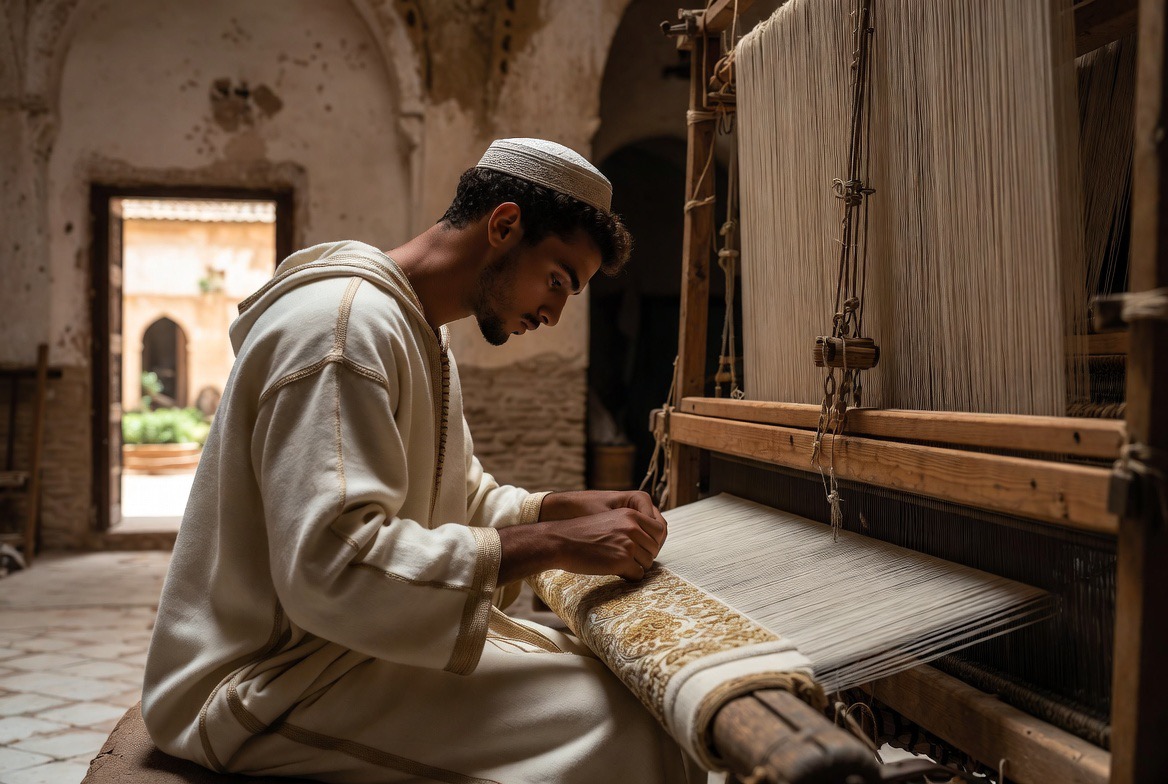
Weaving & Brocade
Silk, gold thread, the drawloom.
The workshop takes up the gesture of tiraz (طراز) — the woven or embroidered inscription that state workshops, the dar al-tiraz (دار الطراز), produced across the medieval Arab world, from Fatimid Egypt to Umayyad al-Andalus. Reserved at first for the sovereign (tiraz khassa), then extended to dignitaries (tiraz ʿamma), the inscribed cloth sealed the khilʿa (خلعة) — the gift of a robe of honor, a gesture as political as it was textile.
This tradition crossed the Mediterranean as far as Palermo, where Arab craftsmen wove, in 1133–34, for Roger II of Sicily, the Norman king, the coronation mantle now kept at the Kunsthistorisches Museum in Vienna: red silk embroidered with gold, pearls, and enamels, bordered with a Kufic inscription giving the place and date of its making, two lions facing camels on either side of a stylized palm tree.
ممّا عُمِلَ بالخزانةِ الملكيةِ المعمورةِ […] بمدينةِ صِقِلِّيَةَ سنةَ ثمانٍ وعشرين وخمسمائة
"What was crafted in the flourishing royal treasury […] in the city of Sicily, in the year five hundred twenty-eight." — inscription embroidered on the hem of Roger II's mantle, royal workshop of Palermo, 528 H / 1133–34
(Transcription and translation after I. Dolezalek, Arabic Script on Christian Kings, De Gruyter, 2017 — the complete inscription, in rhymed prose, lists the virtues and benefits of the royal treasury; only the opening and closing formula, with the place and date, are reproduced here.)
In Fès, gold and silver thread bears its own name: sqalli. An entire guild, the maʿallemin sqalli, is devoted to producing it — gold beaters, rollers, wire-drawers, spinners — before the thread reaches the drawloom, the mrema bejebbad, where the roles are divided: the zouaq draws the pattern, the nyar sets up the loom, the medewar prepares the bobbins, the jebbad weaves, all under the authority of the maalem. A widespread hypothesis, without firm academic confirmation, links the name sqalli to Sicily (Siqilliyya) — a possible echo of this same Mediterranean circuit of gold thread.
This brocade, woven from silk and sqalli thread, has clothed great occasions for centuries. At Dar al-Hiraf, gold thread remains reserved for ceremonial pieces; everyday cloth makes do with silk alone.
نسجوا من الذهبِ الورودَ على الحريرِ
"They wove roses of gold upon the silk."
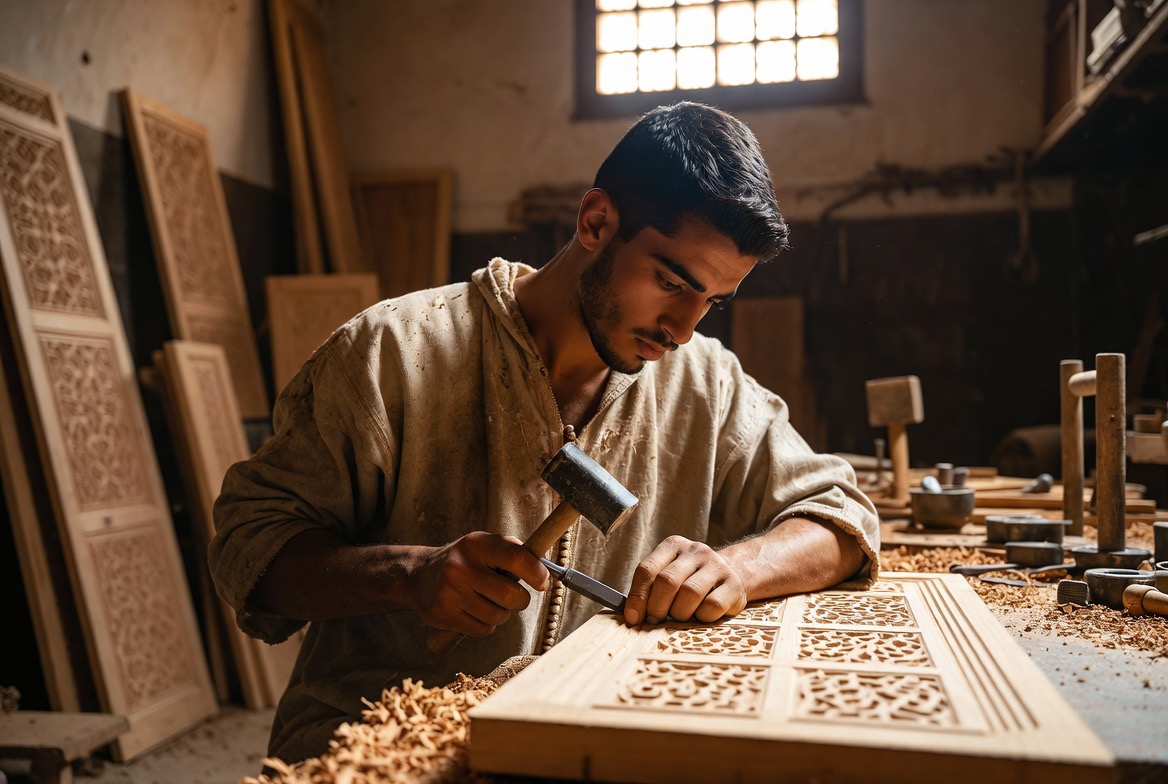
Wood & Carving
Carving, joinery, the patience of cedar.
Cedar from the Middle Atlas, together with plaster and zellige, forms the triad of Moroccan decorative materials. Coffered ceilings and mashrabiya screens bear witness to an art of geometric joinery without nail or glue.
والخشبُ يلينُ تحتَ يدٍ صابرةٍ
"Wood softens under a patient hand."
FÈS
Capital of Arts and Crafts
A refuge city for Andalusian craftsmen after 1492, home to the Qarawiyyin. Under the Marinids, the guilds structured urban life around gesture, honor, and transmission.
Dar al-Hiraf is rooted in this lineage: a formation that unites gesture, honor, and communal life.
These five crafts of the hand find their counterpart on the side of the body, the word, and sound in Music & Chant and Furusiyya, and their own dress in Al-Kiswa.
The terms on this page are gathered in the glossary of the house.